 The King’s Little Crown
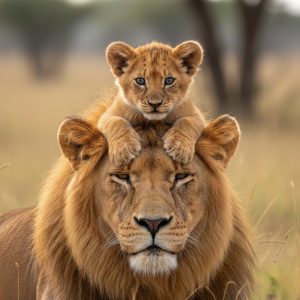
Beneath the endless savannah, where golden grass stretches to the horizon and the wind carries the scent of sun-baked earth, there exists a moment so small yet powerful enough to soften the harshness of nature itself. It is a moment where a male lion — the King of the Jungle — lies still, his piercing eyes fixed calmly ahead, while resting on his head is a tiny, fragile life: his cub. There is no roar, no raised claws, no chase soaked in sweat and survival. Only a rare stillness, a breath of peace in a world governed by unforgiving laws.
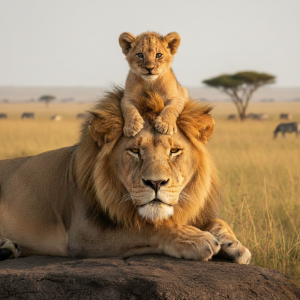
The male lion bears the marks of time. His thick mane, darkened by years under the African sun, frames a face shaped by countless battles. His ears are worn, his gaze deep and steady — no longer reckless, but tempered by experience. He has fought to defend his territory, stood guard through endless nights, and faced rivals who challenged his right to rule. In the wild, the title “king” is not symbolic. It is earned through pain, blood, and the constant balance between dominance and defeat.
Yet, perched atop the head of this powerful ruler sits a cub — relaxed, fearless, and utterly unaware of the weight beneath him. Tiny paws sink into the dense mane, blue eyes wide with curiosity as they absorb the world from a new height. There is no hesitation, no fear. To the cub, this lion is not a symbol of power. He is shelter. He is safety. He is a foundation strong enough to climb, explore, and rest upon without question.
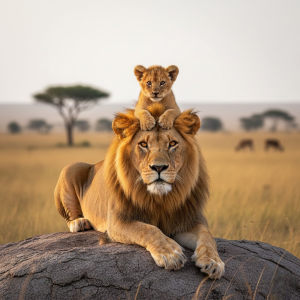
In that instant, one truth becomes clear: behind absolute strength lies a quiet tenderness. The same lion who commands silence across the plains allows himself to become a throne for his child. He does not growl. He does not shake the cub off. He simply remains still, patient, as if understanding that for his cub, this moment is everything.
Male lions are often portrayed as fierce, dominant, even distant. Many describe them as rulers who reap rewards while others hunt. But images like this reveal something rarely seen — moments of fatherhood that exist beyond myth and assumption. When danger approaches, the male lion is the first to stand. When threats emerge, he becomes a living shield. And in moments of rare calm, he becomes something softer: a resting place, a quiet protector, a father.
The cub, with eyes still untouched by hardship, knows nothing of the battles fought to protect this land. He does not know how fragile power can be, how quickly kings fall, how survival in the wild offers no guarantees. He does not yet understand that one day he will have to fight, to endure, to earn his place. For now, he knows only warmth beneath his paws, stability under his tiny weight, and the joy of being “the highest.”
Perhaps the cub is thinking something simple: I’m so high.
I’m on my dad’s head.
The world looks different from up here.
And the father? Perhaps his thoughts are quieter, heavier: As long as you’re safe.
This unspoken exchange transcends species. It exists beyond language, beyond instinct, beyond the boundaries between humans and animals. It is the universal language of fatherhood — fierce and gentle at once, protective yet patient.
The contrast in this moment is impossible to ignore. One face carries the weight of authority, sharpened by survival. The other reflects innocence, untouched by fear. One represents strength. The other vulnerability. And somehow, it is that vulnerability that makes the strength more beautiful.
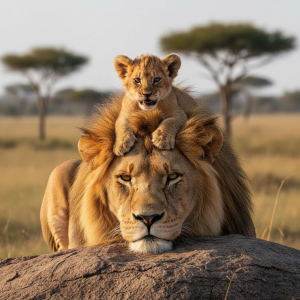
In a landscape where every second revolves around survival, this moment feels like a pause — a breath held gently between heartbeats. It reminds us that even in the harshest environments, love persists. It exists quietly, naturally, without demand or display.
Humans cannot help but see themselves reflected in this scene. So many fathers carry heavy responsibilities, wearing expressions of strength and restraint. They may not speak often of love. They may appear stern, distant, or silent. But when their children need them, they become the ground beneath small feet, the shoulders that bear weight without complaint. Love, in its truest form, is not loud. It is steady.
This tiny “living crown” also symbolizes continuity. One day, the cub will grow. His eyes will sharpen. His mane will thicken. His roar will echo across the plains. He will learn to fight, to protect, to claim his own space in a ruthless world. But before that day arrives, he is allowed to be small. Allowed to be playful. Allowed to trust completely.
And perhaps that is what makes nature so deeply moving — not just its power, but its tenderness hidden within instinct. A still body. Small paws resting above weary eyes. A king allowing himself to be climbed upon. No words are spoken, yet the message is clear.
Among countless images of wildlife, this moment stands apart not because of drama, but because of softness. It teaches us that true power does not lie in dominance or fear, but in the ability to protect without violence, to endure discomfort for another’s joy, and to love quietly.
The greatest crown a king can wear is not gold, nor territory, nor the fear of others — but the trust of a child resting safely upon him.
In that single, fleeting moment, the savannah reveals a universal truth: whether lion or human, ruler or ordinary soul, the bond between father and child is among the most powerful forces in existence.