🐆 A Mother’s Golden Touch
A MOTHER’S GOLDEN TOUCH
Across the vast African savanna, where the earth glows in shades of red and gold and the sky stretches endlessly toward the horizon, there are moments that do not need speed, strength, or spectacle to become extraordinary. They require no roar, no chase, no display of power. All they need is a gentle touch. A shared glance. A quiet presence strong enough to slow the world.
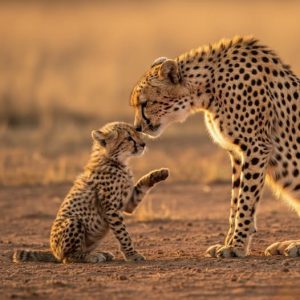
In the soft light of the golden hour, a mother cheetah lowers her head and touches noses with her cub. There is no urgency in the movement. No tension. No hunt in sight. Only love.
It is a moment that whispers a timeless truth: even the fastest and fiercest hunters are shaped by tenderness.
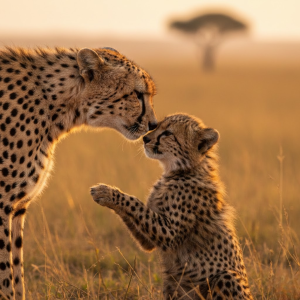
The mother stands tall and graceful, her lean body wrapped in a coat of golden fur patterned with dark rosettes that shimmer in the fading sunlight. Each mark on her body tells a story—of long chases across open plains, of hunger endured, of sleepless nights guarding her young from unseen dangers. Her eyes are trained to scan the horizon, to measure distance, to decide in fractions of a second. Yet now, those eyes soften. They slow. They hold nothing but devotion.
Before her sits the cub—small, unsteady, its legs still learning the language of the earth. It lifts one paw toward its mother, an awkward yet heartfelt gesture of complete trust. The cub does not yet know fear. It does not understand loss or danger or the harsh truths of survival. It knows only this: its mother is here. And that is enough.
That gentle touch is more than instinct. It is a silent message.
You are safe.
I am here.
No matter how vast or unforgiving this world may become, you will not face it alone.
In the wild, there are no spoken lessons, no classrooms, no written rules. Knowledge is passed down through presence and action, through example rather than explanation. And the first lesson a young life learns is not how to hunt, not how to run, but how to trust.
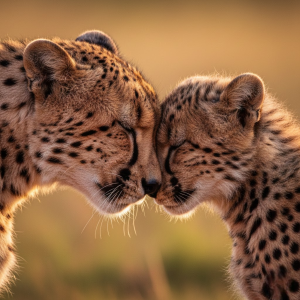
Before the cub learns to sprint across the savanna, it learns to stand beside its mother.
Before it learns to track prey, it learns to meet her gaze.
Before it learns how to survive, it learns what it means to be loved.
The sun sinks lower, and the light grows warmer, wrapping mother and cub in a golden glow that feels almost sacred. A gentle breeze carries the scent of dry grass and sunbaked soil. Beyond this quiet circle, the world continues its restless motion—other predators moving through the tall grass, unseen threats waiting patiently, laws of nature that show no mercy. Yet here, time seems suspended.
There is only the bond between them.
We often describe nature as cruel, as a realm where weakness has no place. And yet moments like this reveal a deeper truth. The wild is not devoid of love—it simply expresses love in ways that are quieter, tougher, and more enduring. Love in the wild does not promise safety forever. It prepares.
The mother cheetah knows she cannot protect her cub indefinitely. One day, she will have to step aside and allow it to face the world alone. She will watch from a distance as it stumbles, fails, and learns. She understands this truth deeply, instinctively. But for now—for this moment—she stays. Fully present. Fully devoted.
Some moments do not need to last long to become eternal. This touch will pass. The sun will set. The cub will grow. But the feeling of safety, of being held by love itself, will remain—etched into instinct, carried forward into every step the cub takes across the open plains.
When humans look upon this scene, we often see ourselves reflected in it. We see the mother who stayed awake through the night, listening for danger. The parent who watched from afar as their child took uncertain first steps. We see ourselves as we once were—small, protected, loved before we ever had to be strong.
Perhaps that is why this moment reaches us so deeply. Not because it is rare, but because it is universal.
A mother’s love does not seek attention. It does not demand recognition. It exists in the smallest gestures: a touch, a watchful gaze, a presence that never truly leaves. In a world where mistakes can cost a life, that love becomes the foundation of survival itself.
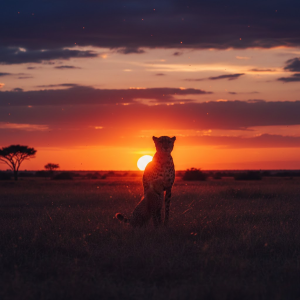
As the sun finally slips beneath the horizon and the golden light fades into amber, then into shadow, the mother and her cub remain close. Side by side. Bound not by words, but by something far older and stronger.
The savanna will move on. Night will fall. The endless cycle of life will continue. But this moment—this golden touch—endures as a quiet reminder:
Before speed, there is love.
Before strength, there is care.
Before survival, there is connection.
And in every world, no matter how wild or unforgiving, a mother’s love remains the most powerful force of all.