

The Heart of the Pride
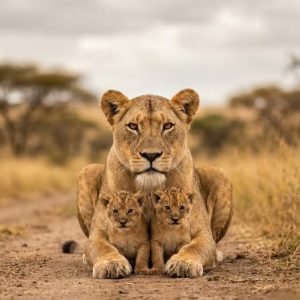
Amid the vast openness of the African savanna, where the golden hues of dry grass blend seamlessly with the soft light of the sky stretching to the horizon, the image of a lioness sitting quietly with her two cubs emerges as a timeless symbol of life itself. Without dramatic movement or thunderous roars, the lioness tells a powerful story through her steady posture and calm gaze—a story of motherhood, responsibility, and silent strength in the natural world.
Lions have long been regarded as the “kings of the wild,” symbols of power, dominance, and courage. Yet behind the iconic image often associated with the male lion’s mane and roar lies a deeper truth: it is the lioness who forms the true heart of the pride. In this image, the lioness sits low to the ground, her front legs firmly placed, naturally forming a protective frame around her cubs. This posture is more than a physical shield; it is a quiet declaration of a mother’s role in nature—ever-present, ever-watchful, and unwavering in her devotion to her young.
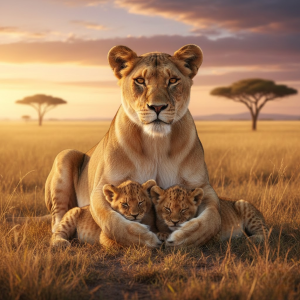
The lioness’s eyes face forward, neither aggressive nor fearful, but intensely alert. This is the gaze of a creature shaped by experience, fully aware of the dangers that surround her. The savanna, though seemingly peaceful, is a land of constant risk: rival predators, harsh weather, and the relentless challenge of finding food. In such an environment, the survival of the cubs depends entirely on the mother’s vigilance, knowledge, and instinct. Her gaze becomes an invisible barrier, silently promising safety: As long as I am here, you are protected.
Nestled between her paws, the two cubs appear small and fragile, their rounded faces and curious eyes reflecting innocence and trust. They are not yet aware of the harsh realities of the world beyond their mother’s embrace. In this moment, however, they occupy the safest place they could possibly be. The contrast between their tiny bodies and the lioness’s strong, grounded form emphasizes the essence of protection—a theme that transcends species. Just as in the animal kingdom, every young life requires a steady foundation upon which to grow.
What makes this image truly remarkable is not only its visual harmony but the emotion it evokes. The viewer can sense tenderness embedded within strength. The lioness is the primary hunter of the pride, a warrior capable of facing immense danger to secure food and defend territory. Yet in the presence of her cubs, that same strength transforms into patience, gentleness, and care. This balance creates a profound beauty: powerful without cruelty, nurturing without weakness.
In the natural world, the role of the lioness is essential to the survival of the pride. She hunts, raises the young, teaches them the skills they will need, and cooperates with other lionesses to protect their shared domain. The two cubs in this image are not only her offspring but also the future of the pride itself. Every moment of protection today is an investment in tomorrow, ensuring that the cycle of life continues unbroken.
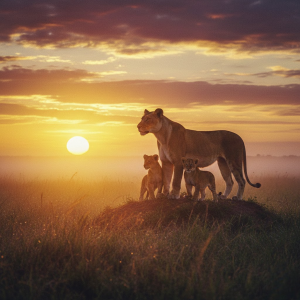
The vast savanna in the background further deepens the symbolic meaning of the scene. There are no fences, no permanent shelters—only open land governed by unforgiving natural laws. Within this immense and unpredictable environment, the small family of lions becomes a warm focal point, reminding us that even in the harshest conditions, love and connection endure. Nature is not solely about competition and survival; it is also about bonds, cooperation, and care.
This image invites reflection beyond the animal world and into human life. In modern society, where daily routines are fast-paced and pressures are constant, people often overlook the importance of presence and protection. The lioness does not need grand gestures to express love. Simply being there—strong, attentive, and grounded—is enough to give her cubs a sense of security. It is a powerful lesson in quiet strength: love does not always announce itself loudly, yet its impact can be profound and lasting.
Moreover, the image serves as a gentle reminder of humanity’s responsibility toward wildlife and the natural environment. Today, lions face declining populations due to habitat loss and human activity. Every photograph that captures such an intimate and authentic moment becomes more than art; it becomes a silent call for awareness and conservation. These scenes are not guaranteed to exist forever, and their preservation depends on the choices humans make now.
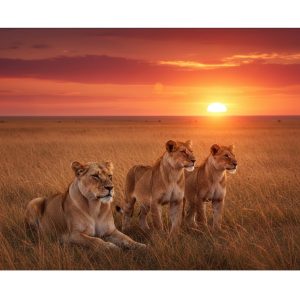
Ultimately, The Heart of the Pride is more than a photograph of a lioness and her cubs. It is a story of motherhood, of strength intertwined with compassion, and of life passed from one generation to the next. In the lioness’s calm, watchful eyes and the cubs’ innocent closeness, we find a universal truth that transcends species and boundaries: the foundation of survival and hope is built upon protection, care, and love.
Against the endless horizon of the savanna, this single moment is preserved as a quiet yet powerful reminder that whether among humans or animals, the heart of life begins with guardianship—and endures through devotion.