 The King’s Little Crown
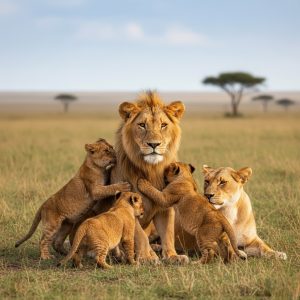
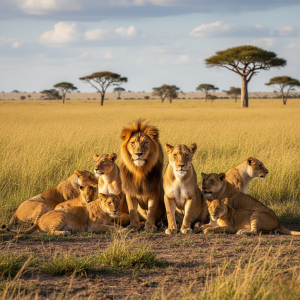
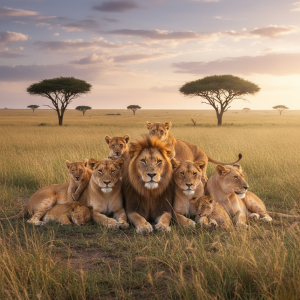
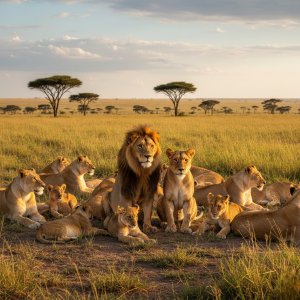
Beneath the pale blue sky of the African savanna—where golden grass stretches endlessly toward the horizon and lone acacia trees stand silently as witnesses of time—there exists a moment that seems small, almost insignificant, yet holds within it an entire universe of emotion. It is the moment when a male lion—the king of the wild—sits motionless in the open grassland, allowing his tiny cubs to climb over him, cling to him, and wrap themselves around his massive body as if it were the whole world.
He does not roar.
He does not move.
He does not resist.
He simply remains still.
And within that stillness, we see power. But deeper than that, we see love.
Male lions are often spoken of as symbols of strength, dominance, and raw authority—creatures of sharp claws and fearsome jaws. We hear stories of their thunderous roars echoing for miles, of their proud strides, of the piercing gaze that commands respect across the plains. Yet this image tells a different story—one rarely spoken aloud: the story of a father’s gentleness.
The lion cubs, with their soft fur and wide, curious eyes, know nothing of the concept of a “king.” To them, the enormous lion before them is not a ruler or a hunter. He is safety. He is home. He is a place to climb, to wrestle, to explore the world with clumsy paws and fearless curiosity.
One cub clings to his mane, tiny claws lightly gripping the thick fur. Another presses its small forelegs against his chest, as if checking whether that great heart beneath is still beating. The smallest lingers in front, head slightly tilted, as though deciding whether to join the game or simply watch. And there the lion sits—upright, composed, eyes gazing calmly ahead—while a living, breathing “crown” wriggles and tumbles atop his head.
It is impossible to look at this scene without smiling.
Because no matter the species, fatherhood seems to take the same form.
It is silent sacrifice.
It is strength set aside to make room for patience.
It is enduring discomfort, exhaustion, even pain—simply so a child can feel joy.
In the unforgiving world of the wild, where each day is a struggle for survival, such softness feels especially precious. A male lion cannot always be present. He must defend territory, confront rivals, and face constant threats from other males seeking to take over. Yet when he is with his cubs, he becomes something else entirely—steady, grounded, and endlessly tolerant.
Perhaps that is why this image resonates so deeply with us.
Because within it, we see ourselves.
A father sitting still while his child climbs onto his shoulders.
A father wearing a serious expression while his heart quietly melts.
A father who may never say “I love you,” yet allows the entire world to climb all over him without complaint.
The “crown” upon the lion’s head is not made of gold or jewels. It is woven from tiny paws, from quick breaths, from the absolute trust that only children can give their parent. It is a crown of responsibility. Of protection. Of unconditional love.
In the lion’s eyes, there is no irritation. Only acceptance. As if he understands that these moments are fleeting. One day, the cubs will grow. They will no longer climb over him or tug at his mane. They will learn to hunt, to fight, to survive in a world that shows no mercy. And when that day comes, today’s playful chaos will exist only as memory.
Perhaps that is why he stays still.
Because being a father is not always about teaching or guiding.
Sometimes, it is simply about being there.
Being there for a child to lean on.
Being there while they make mistakes.
Being there so they can feel safe.
This image also reminds us that true strength does not lie in inspiring fear, but in the ability to restrain one’s power for the sake of what one loves. The lion could easily stand up, shake his cubs off, and walk away. But he does not. He chooses patience. And in that choice, he becomes greater than any roar could ever make him.
Amid the vast savanna, this small moment feels like a gentle note within nature’s wild and relentless symphony. It reminds us that even in the harshest corners of the world, love exists—quiet, unshowy, yet enduring.
And if we linger with this image long enough, we may come to understand something deeply human:
Anyone can be a king.
But not everyone has the patience to wear the “crown” their children place upon their head.
And that—
That is the noblest form of royalty of all.