👑 Side by Side: The Future of the Pride 🦁
Side by Side: The Eternal Legacy of the Pride
In the raw, unfiltered theater of the natural world, we are often captivated by the high-stakes drama of the hunt—the explosive speed of a chase, the raw power of a predator, and the uncompromising law of the jungle. Yet, the most profound stories of the wild are often written in the quiet intervals between the storms. The portrait of a lioness cradling her sleeping cub amidst a parched landscape is one such story. It is a visual poem about the “quiet strength” that sustains life, a testament to a bond that is as old as the earth itself, and a poignant look at the future of a species that defines the very concept of majesty.
1. The Symphony of the Scorched Earth
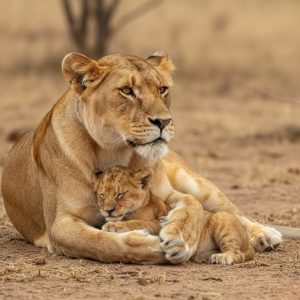
While many romanticize the African savanna as an endless sea of lush green grass, the reality captured in this image is much more grit-filled and honest. They sit not on a verdant carpet, but on the dust-choked, sun-bleached soil of the dry season. This setting is crucial to understanding the narrative. In the wild, “lushness” represents ease, while “aridness” represents the ultimate test of character.
The golden-brown hues of the earth perfectly mirror the tawny coats of the lions, creating a sense of belonging—they are not just inhabitants of this land; they are an extension of it. The dry grass and the hazy, out-of-focus background evoke the shimmering heat of the afternoon sun. In this environment, every movement costs energy, and every shadow is a sanctuary. The fact that the lioness chooses this moment to rest and embrace her cub, despite the harsh conditions, highlights the resilience of life. It reminds us that beauty does not require a perfect environment to flourish; it only requires a reason to survive.
2. The Lioness: A Fortress of Tenderness
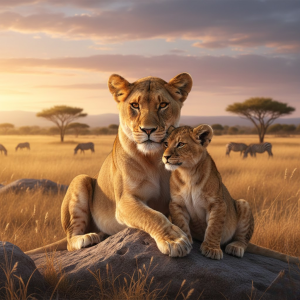
The lioness is the true protagonist of the savanna. While the male lion stands as a symbol of territorial authority, the lioness is the architect of the pride’s survival. She is the strategist, the provider, and the primary protector. In this portrait, we see a side of her that is rarely celebrated in popular media: her capacity for profound tenderness.
Look closely at her posture. She isn’t just sitting near her cub; she has created a physical fortress. Her massive forelimbs, capable of bringing down a Cape Buffalo, are folded with surgical precision to create a cradle. This is the “regal grace” mentioned in the original description—a grace that comes from the total control of immense power.
Her eyes, amber and piercing, do not look down at her child. Instead, they scan the horizon. This is the dual burden of motherhood in the wild. She must be soft enough to be a bed for her cub, but sharp enough to detect a hyena or a rival pride from miles away. Her expression is one of “vigilant peace.” She is the bridge between the cub’s current vulnerability and its future dominance.
3. The Sleeping Cub: A Promise Wrapped in Fur
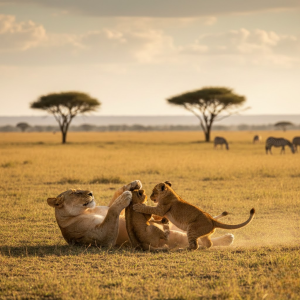
Tucked away in that muscular embrace is the cub, blissfully unaware of the harsh world beyond its mother’s fur. While one might expect a “curious” cub exploring its surroundings, the reality of a sleeping cub is perhaps more moving. Its closed eyes and relaxed features represent the highest form of trust found in nature.
For the cub, the mother is the entire universe. Her scent is safety; her warmth is life. This cub represents the “Future of the Pride,” a tiny spark of potential that will one day grow into a formidable force. But today, it is simply a child. The spots still visible on its fur—a natural camouflage for the very young—remind us of its fragility.
This image captures the “silent education” of the wild. Even in sleep, the cub is learning. It learns the rhythm of its mother’s heartbeat, the sound of her breath, and the feeling of being protected. These early moments of security are the foundation upon which its later confidence will be built. To lead a pride, one must first learn what it feels like to be held by one.
4. The Philosophy of Protection
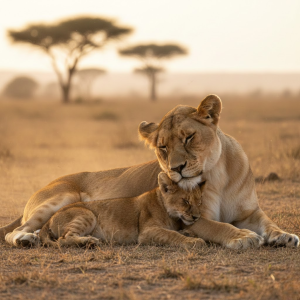
There is a profound lesson in this image for the human observer. We often equate strength with aggression, but the lioness teaches us that the highest form of strength is protection.
The bond between the mother and cub is a biological imperative, yes, but it is also a display of emotional intelligence. In the social structure of lions, the “Pride” is everything. Individual survival is secondary to the continuation of the lineage. By nurturing this single cub, the lioness is ensuring that the stories of her ancestors—the Great Hunters of the past—will continue to be told through the roars of the future.
This “Side by Side” existence is the heartbeat of the savanna. It is a reminder that no one, not even a lion, survives alone. Success is a collaborative effort, passed down from one generation to the next through patience, sacrifice, and an unwavering commitment to the “next in line.”
5. A Call to Preserve the Majesty
As we gaze upon this stunning portrait, we must also acknowledge the invisible shadows. The “Future of the Pride” is not just threatened by natural predators or droughts; it is threatened by the shrinking of the wild itself.
The “promise for the next generation” symbolized by the cub can only be kept if there is a savanna left for it to rule. Images like this serve as a powerful bridge between our world and theirs. They move us because they mirror our own values: the love of a parent, the innocence of a child, and the desire for safety.
By witnessing this moment of peace, we are called to be the protectors of the protectors. Just as the lioness guards her cub, humanity must guard the habitats that allow these magnificent creatures to exist. The resilience of the wild is great, but it is not infinite.
Conclusion: The Sun Never Sets on the Bond
The light in the photograph is fading into the soft glow of the late afternoon, a “golden hour” that bathes the duo in a heavenly radiance. It is a moment frozen in time, yet it speaks of a cycle that is eternal.
The lioness will eventually stand up, shake the dust from her coat, and lead her cub toward the next waterhole or the evening hunt. The cub will wake up, perhaps with a playful pounce, and follow the flick of its mother’s tail. Life will continue in its beautiful, brutal, and breathtaking way.
“Side by Side” is more than just a caption; it is the fundamental law of the pride. As long as there is a mother to watch and a cub to learn, the spirit of the wild remains unbroken. This image is a masterpiece of nature, reminding us that in the heart of the harshest desert, love is the most fertile ground of all.