 The Quintessential Cheetah Family Portrait
THE CHEETAH FAMILY PORTRAIT – A SILENT EPIC OF NATURE
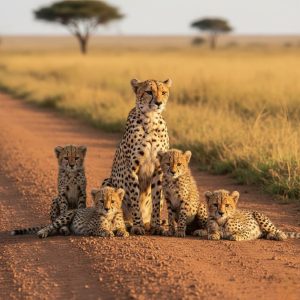
In the vast expanse of the African savanna, where the sky stretches endlessly and the land is bathed in shades of gold from dry grass and warm sunlight, there exists a quiet yet powerful moment: the image of a cheetah family appearing like a perfectly composed portrait of the natural world. Without words, without dramatic movement, the photograph tells a profound story of motherhood, survival, and the raw beauty of wildlife.
At the center of the composition sits the mother cheetah—upright, poised, and intensely alert. Her slender body, marked by distinctive black spots against a pale golden coat, embodies both elegance and strength. She is the result of perfect evolution: the fastest land animal on Earth, a master hunter of the plains. Yet in this moment, she is not defined by speed or pursuit. Instead, she represents protection and responsibility. Her watchful gaze scans the surroundings not only for danger, but as if safeguarding the future embodied in the four small lives resting beside her.
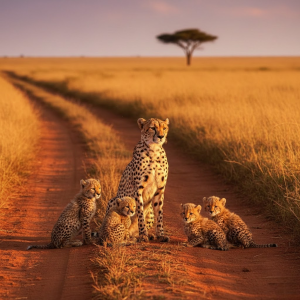
Surrounding the mother are her four cubs, each lying in a slightly different posture, each wearing a unique expression, yet all radiating innocence, vulnerability, and complete trust. Their fur is still soft and downy, their spots not yet as bold or defined as those of an adult cheetah. They rest together on a red dirt track—a path that could belong to humans, yet also serves as a fragile boundary between safety and danger. This close clustering emphasizes the role of family in the wild: in a world where survival is never guaranteed, maternal care becomes the strongest shield of all.
The surrounding landscape completes the scene. The savanna stretches endlessly, golden grasses swaying gently in the breeze, while in the distance stands the iconic acacia tree, a silent witness to the passage of time. Warm afternoon light blankets the entire image, creating a rare sense of calm in an otherwise harsh environment. This light does more than illuminate form and texture; it evokes hope—hope for continuity, for growth, for a new generation that will rise to meet the challenges of the wild.
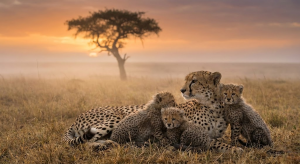
While the photograph is undeniably beautiful, its significance extends far beyond aesthetics. It serves as a poignant reminder of the fragility of nature. Cheetahs are a species facing serious population decline due to habitat loss and human impact. When one looks into the mother’s vigilant eyes and the cubs’ trusting faces, it becomes impossible not to wonder about their future. Will these dirt roads remain quiet passages through the wild, or will they become symbols of encroachment and disruption by the modern world?
On a symbolic level, the cheetah family mirrors human life itself. Across all species, family is the origin of existence, the foundation of learning and growth. The mother cheetah will teach her cubs how to hunt, how to run, how to hide, and how to survive in a world filled with danger. These lessons are not merely physical skills; they represent the transmission of experience, instinct, and wisdom accumulated over generations. In this way, the wild becomes a classroom, and motherhood its most dedicated teacher.
The near-symmetrical arrangement of the cubs around their mother creates the impression of a small protective unit, almost like a miniature honor guard. Though they are weak and inexperienced, their presence completes the image of the mother. She is no longer a solitary predator but the heart of a small universe, where every movement and every breath is tied to collective safety. This is the beauty of connection—a quiet, unassuming beauty that nonetheless reaches deep into the viewer’s emotions.
The photograph also stands as a testament to the power of wildlife photography. In a single frame, the photographer has frozen an unrepeatable moment, one in which time itself seems to pause. The viewer does not merely see the scene but feels it—the stillness of the plains, the tension in the mother’s posture, the calm assurance of the cubs. This is the unique power of imagery: it transcends language and culture, communicating universal truths through light, composition, and emotion.
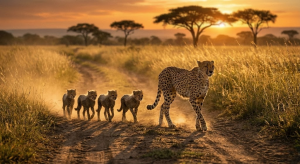
Moreover, the dirt road beneath the cheetahs subtly reinforces the complex relationship between humans and nature. It suggests proximity—perhaps even intrusion—yet in this moment, harmony prevails. The animals remain undisturbed, embodying resilience and adaptability. Still, the road reminds us that such balance is delicate and easily broken. It challenges the viewer to consider humanity’s responsibility toward the natural world.
Ultimately, this cheetah family portrait is far more than a beautiful image. It is an invitation to reflect. It calls upon us to appreciate the natural world, to respect all forms of life, and to recognize our role in protecting wildlife and preserving fragile ecosystems. Beneath the golden sun of the savanna, on a quiet red-earth road beside a lone acacia tree, this cheetah family becomes a symbol of enduring life, sacred motherhood, and the timeless beauty that nature offers to those willing to truly see.