 Clash of the Titans: A Battle for Supremacy
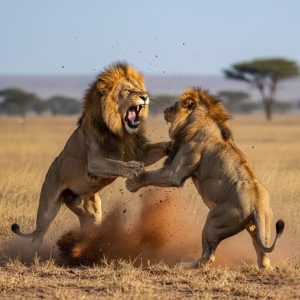
THE CLASH OF KINGS – A FEROCIOUS SYMPHONY OF THE WILD
Amid the vast savannah, where the blue sky stretches endlessly toward the horizon and the earth is scorched golden by sun and wind, nature reveals not only its tranquil beauty but also its most brutal and uncompromising face. The photograph capturing the moment two male lions collide in a violent confrontation is more than a breathtaking scene—it is a powerful symbol of the harsh laws that govern the wild, where strength, instinct, and willpower determine survival.
Two massive bodies explode upward from the ground, sending clouds of dust swirling violently into the air. Razor-sharp claws extend in challenge, and powerful jaws gape wide in thunderous roars that tear through the silence of the plains. In that frozen instant, it feels as though the entire savannah holds its breath, bearing witness to the confrontation of two kings. There is no mercy here, no room for weakness—only victory or defeat.
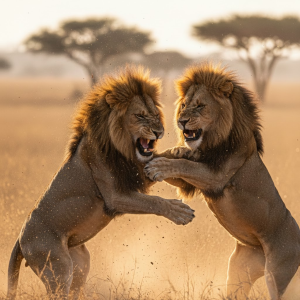
For centuries, lions have been revered by humans as the “Kings of the Jungle.” This title comes not only from their physical power, but also from their commanding presence: the thick mane resembling a royal crown, the piercing gaze of a ruler who fears no rival. Yet in the wild, kingship is never permanent. Power is not inherited—it must be seized, defended, and constantly proven, often at a tremendous cost.
The clash depicted in the photograph is most likely a battle for territory or dominance. For a male lion, controlling land means controlling life itself. Territory grants access to food, safety, and the pride—the lionesses through whom his lineage may continue. The victor earns the right to rule, while the defeated, if spared, is often forced into exile, condemned to roam alone across the unforgiving plains where danger lurks at every turn.
What makes this image extraordinary is not merely the violence it portrays, but the sense of fragile balance between power and survival. The two lions appear evenly matched, their stances mirroring one another, as if nature itself has placed them on opposite sides of a deadly chessboard. This is not a surprise attack—it is a direct challenge, an unspoken declaration of war between equals.
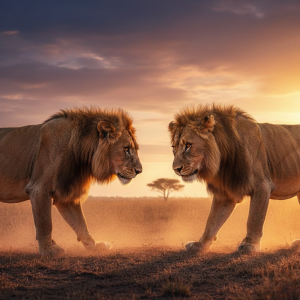
Despite their ferocity, such battles are usually brief. Lions instinctively understand that serious injury can be more lethal than defeat. A wounded lion may starve, unable to hunt, or fall victim to other predators. For this reason, most confrontations rely heavily on intimidation—roaring, posturing, and displays of strength. Only when neither rival yields does the conflict escalate into full physical combat, where everything is risked for supremacy.
Beyond its biological reality, the clash of these two lions invites deeper reflection on the human condition. Although modern humans no longer fight with claws and teeth, competition remains an inseparable part of life. We battle for success, recognition, and influence—in classrooms, workplaces, and societies. Like the lions, we face moments when our resilience, courage, and determination are tested.
Yet unlike animals, humans possess the ability to choose how we compete. We can pursue progress through intelligence rather than violence, cooperation rather than destruction. In this sense, the photograph becomes more than a wildlife image—it becomes a reminder of the value of restraint, balance, and responsibility.
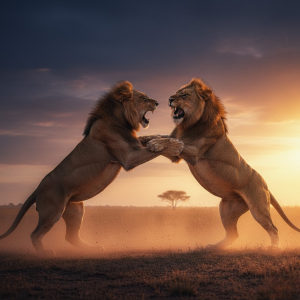
Artistically, the photograph is a masterpiece of timing and composition. Capturing the precise moment when both lions are suspended mid-air requires not only technical skill, but immense patience and intuition. The natural lighting, the symmetrical framing, and the dramatic dust clouds transform a fleeting instant into a timeless visual narrative. This is not merely a photograph—it is a story told without words.
In an era when human activity continues to shrink and fragment natural habitats, images like this grow increasingly precious. They remind us that beyond our cities and technologies exists a world governed by ancient laws, where humans are not the central force. Preserving wildlife and their ecosystems is not just an act of compassion—it is a responsibility to maintain the planet’s balance and biodiversity.
Ultimately, the question “Who will be king?” is far less important than the truth it reveals: no power lasts forever. Every victory is temporary. Every ruler will eventually be challenged. The only constant is nature’s relentless yet impartial law.
The photograph freezes a moment of conflict, but life on the savannah continues uninterrupted. No matter who emerges victorious, the sun will rise again, winds will sweep across the dry grasslands, and the eternal cycle of life and death will carry on. In this raw intensity, nature reveals itself as both cruel and magnificent—and humanity, as an observer, cannot help but feel humbled by the primal power of the wild.