 The Strength of a Mother
THE STRENGTH OF MATERNAL LOVE – THE HEART OF THE PRIDE
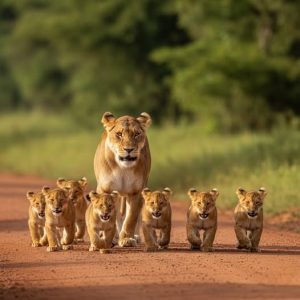
Amid the vast expanse of the African savanna, where earth and sky blend into warm shades of gold under the sun, the image of a lioness quietly leading her six cubs along a dusty red path leaves a profound impression on the viewer. This is not merely a beautiful moment captured in nature, but a powerful symbol of maternal love, leadership, responsibility, and the journey of growth. The image evokes deep reflections on family, unity, and the irreplaceable role of a mother in any community—whether in the wild or in human society.
First and foremost, the image of the lioness walking at the front clearly illustrates the natural leadership of a mother. In the animal kingdom, lionesses are not only the ones who give birth but also the backbone of the pride. They are the primary hunters, the defenders of territory, and the teachers who guide the next generation in learning how to survive. The focused gaze and steady stride of the lioness in the image reflect constant alertness—an alertness born from love and responsibility. Every step she takes is not simply a movement along the dusty road, but a step toward securing the future of her cubs.
Closely following behind her are six young lion cubs, small yet full of life. They walk almost in unison, staying close to their mother, as if instinctively knowing that safety lies in not straying from her path. This sense of unity and closeness reflects a profound truth of nature: no individual can survive or thrive alone. From an early age, the cubs learn the most important lesson of all—the lesson of trust and togetherness. They trust their mother, trust the path she chooses, and trust that moving forward as a group makes them stronger than walking alone.
The image also highlights the process of learning through observation and imitation. In the wild, there are no classrooms or textbooks—only experience passed down from one generation to the next. The synchronized steps of the cubs show that they are learning how to move, how to maintain formation, and how to observe their surroundings, all by following their mother. This strongly mirrors the way children learn within human families. Young people do not learn solely from spoken instructions, but from daily actions, attitudes, and ways of living demonstrated by their parents.
Another powerful element conveyed by the image is resilience and perseverance. The red dirt road is far from smooth, and the environment is filled with potential danger, yet the lioness moves forward without hesitation. This unwavering determination is a clear expression of maternal love—a quiet yet incredibly powerful force. The mother cannot afford to falter, because behind her walk vulnerable lives that depend entirely on her strength and judgment. In this moment, the lioness is not merely an animal; she is the embodiment of protection, sacrifice, and responsibility.
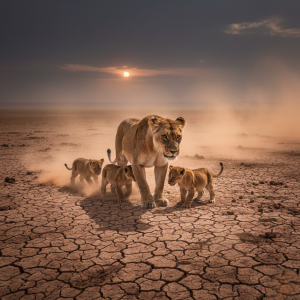
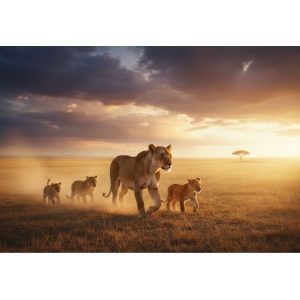
The beauty of the image lies not only in its subjects but also in the natural setting that surrounds them. The African savanna appears vast, raw, and unforgiving. It is precisely this harshness that further highlights the value of family bonds. In a world governed by the relentless laws of survival, maternal love becomes the most stable foundation. Nature in this image is not just a background—it is a reminder that life itself is a journey filled with challenges, and that only love and unity enable individuals, both human and animal, to endure and grow.
From the image of the lioness and her cubs, it is easy to draw parallels to the role of mothers in human life. Across cultures and throughout history, mothers have always been symbols of quiet sacrifice. A mother walks ahead, facing hardships so that her children may have a clearer path forward. She may not speak often of her struggles, but every action is infused with deep and unconditional love. Like the lioness on the savanna, human mothers guide, protect, and prepare their children for the world, often without expecting recognition or reward.
The image also carries a powerful message about the journey toward the future. The cubs walk forward without knowing exactly what lies ahead, yet they continue because their mother leads the way. This scene serves as a strong metaphor: the future is always uncertain, but with proper guidance, love, and companionship, the path becomes less intimidating. This message resonates deeply not only with parents but also with young people who are navigating their own paths toward independence and adulthood.
Another important aspect revealed in the image is the balance between strength and gentleness. Lions are widely seen as symbols of power and dominance, yet in this moment, strength is expressed through care and protection. This reminds us that true strength does not lie solely in physical force or authority, but in the ability to love, nurture, and take responsibility for others. This is a meaningful lesson for modern society, where strength is sometimes misunderstood as control rather than compassion and accountability.
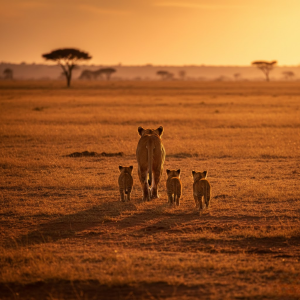
Ultimately, the image of the lioness leading her cubs is a deeply human reminder of the value of family and connection. In today’s fast-paced and pressure-filled world, people sometimes forget the importance of walking together, supporting one another, and protecting those who are more vulnerable. This simple yet powerful image invites us to pause and reflect: have we truly appreciated those who quietly walk ahead of us, guiding and shielding us along the way?
“A mother’s love is the heart of the pride.” This statement is not only true in the world of lions, but across all forms of life on Earth. Maternal love is the source of life, the foundation of growth, and the most enduring strength that enables every individual to move forward with confidence. Through the image of a lioness and her cubs, we see not only the beauty of the wild, but also a reflection of ourselves—as children, as parents, and as members of the greater family of humanity.