A costly mistake: the leopard had to pay the ultimate price.
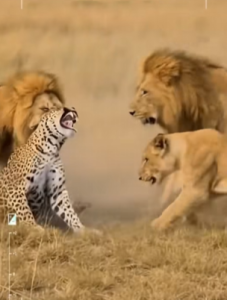
In the heart of the vast African savanna, where the earth lies cracked and scarred by time, life is never peaceful for long.
The wind sweeps across the golden grasslands, carrying with it the scent of dust, blood, and raw instinct. In this land, there is no right or wrong, no good or evil—only those who survive and those who fall.
A male lion moves slowly forward, his massive body cloaked in dark golden fur that ripples with each breath. Dust clings to his mane, and his amber eyes glow with cold awareness. He is not in a hurry. The king of the savanna has never needed to rush. Every step he takes carries the weight of dominance, experience, and countless battles etched deep into muscle and bone.
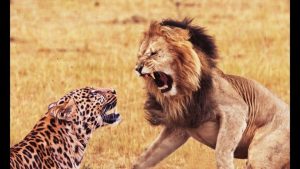
Ahead of him, lying low in the flattened grass, a cheetah struggles. Its slender body—built for speed—now curls inward in desperate defense. The spotted coat that once symbolized grace and velocity is smeared with dirt and dust. One of its hind legs trembles, no longer strong enough to lift its body and flee. In its wide, dark eyes flickers panic, mixed with resignation—the understanding of a cruel and unbreakable law.
For a moment, time seems to slow.
The wind whispers across the plains like the voices of spirits long gone. Creatures that once ran, hunted, fought—all have dissolved into sand and memory. There are no spectators here. No cheers. No mercy. Only two lives, facing each other in a moment where fate is decided.
The lion lowers his head. White fangs gleam beneath thick lips. A low, rumbling growl escapes his chest—not loud, not dramatic, but absolute. It is not a warning. It is a sentence.
The cheetah tries to roll away, claws slashing at the empty air in one final reflex of survival. It is not weak. It is a hunter, a master of speed, feared by gazelles and hares alike. But speed means nothing when there is nowhere left to run. The savanna is endless—until suddenly, it is not.
Dust erupts as the lion lunges forward.
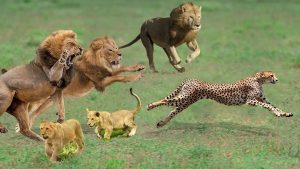
Hundreds of kilograms crash down upon a body far lighter, far more fragile. The moment is swift, decisive, and brutally efficient—just as nature intends. There is no hesitation. No cruelty. Only instinct. Survival allows no second thoughts.
Pinned to the earth, the cheetah lifts its gaze toward the pale blue sky above. In that brief instant, memories may flash—early mornings sprinting across open plains, flawless hunts, the wind slicing past its face as its body reached impossible speeds. A life born to run ends when running is no longer possible.
The lion holds his prey firmly, breath hot and heavy. This is not a personal victory. It is simply the continuation of an endless cycle: hunt, live, endure. Tomorrow—or someday—the lion himself may become slower, weaker, replaced by a younger rival. But today, he stands at the peak.
Around them, the savanna remains indifferent. Grass sways in the breeze. The sun hangs high, cold and impartial, shining upon all living things without judgment. Nature does not pause to mourn. It does not change course for any death.
And in that indifference, the savage beauty of the wild reveals itself most clearly.
This scene is more than a clash between two predators. It is a portrait of life stripped bare—where strength is mandatory, adaptation is survival, and every creature must fight to exist. No one is guaranteed tomorrow. No one is spared.
The lion lifts his head. The tension fades from his eyes. The battle is over. A stronger wind sweeps across the plain, scattering the dust still suspended in the air, as if erasing all traces of the struggle that just occurred.
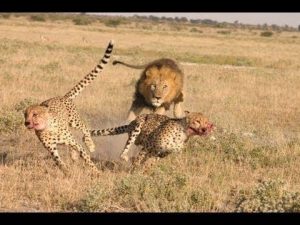
In the distance, life continues. Antelope graze. Birds glide across the sky. And the savanna—vast, merciless, and breathtaking—endures, witnessing everything while saying nothing.
Because here, silence is the ultimate law.